
Healthy, glowing skin is not simply about having a fair or flawless complexion. Good skin health involves maintaining an even skin tone, smooth texture, adequate hydration and a strong skin barrier. However, factors such as pollution, sun exposure, stress, inadequate sleep, lifestyle habits and unsuitable skincare products can leave the skin looking dull, uneven or tired.
A medi-facial is a dermatologist-recommended facial treatment that combines skincare with medically guided techniques to improve the overall appearance and health of the skin. Unlike a conventional salon facial, a medi-facial can be customized according to an individual’s skin type, concerns and treatment goals.
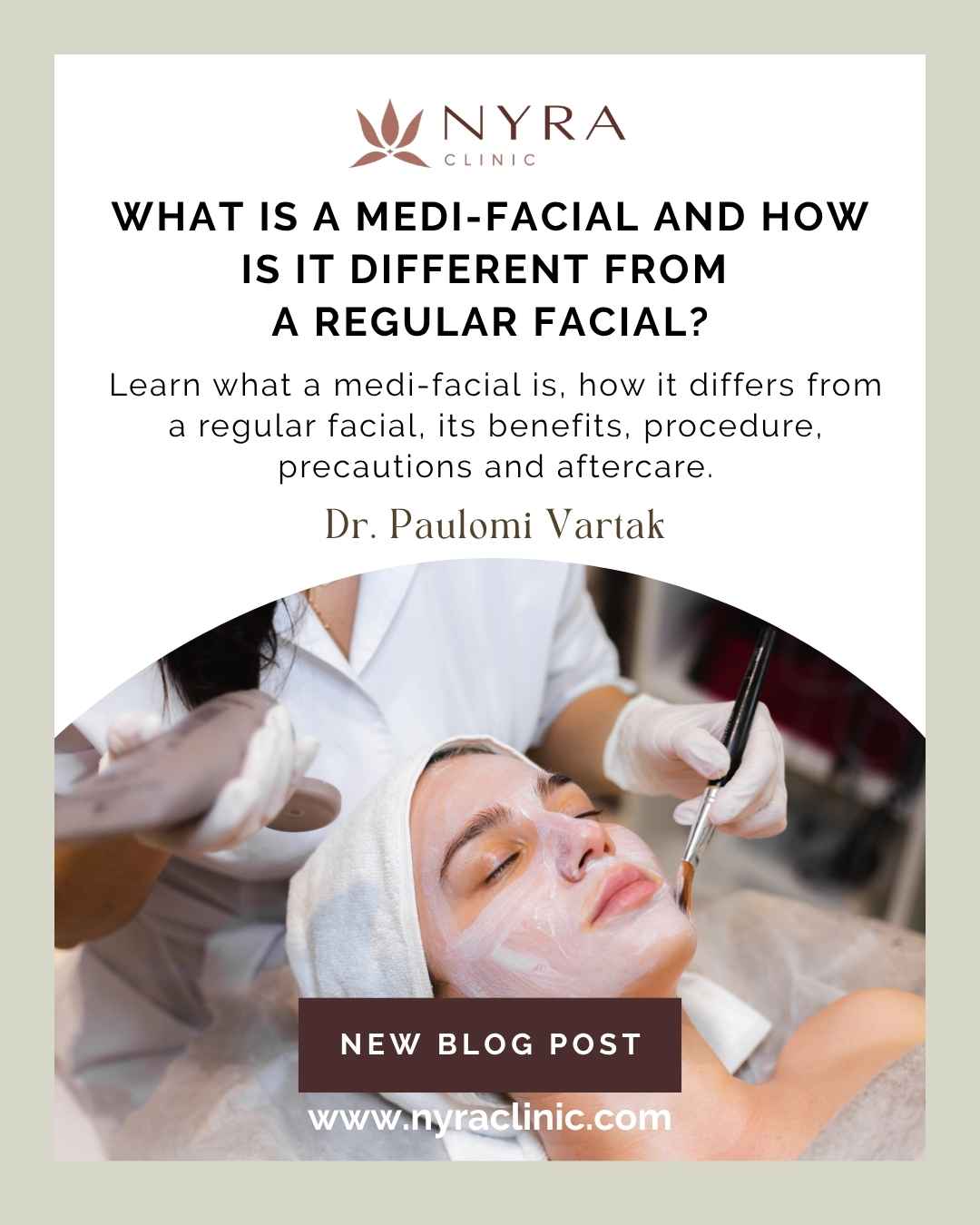
At Nyra Clinic in Pune, Dr. Paulomi Vartak, Dermatologist, evaluates the skin before recommending an appropriate treatment approach. This personalized approach helps ensure that the treatment is suitable for the individual’s specific skin needs.
A medi-facial, also known as a medical facial, is a professionally supervised facial treatment designed to improve skin quality using medical-grade skincare products and advanced techniques.
Depending on the individual’s skin condition, a medi-facial may focus on concerns such as:
- Dull or tired-looking skin
- Uneven skin texture
- Mild pigmentation
- Uneven skin tone
- Excess oiliness
- Dehydrated skin
- Skin congestion
- Rough or dry skin
- Loss of skin radiance
The exact procedure and products used can vary depending on the person’s skin type and concerns.
A key feature of a medi-facial is customization. Instead of following the same facial routine for everyone, a dermatologist can assess the skin and determine which ingredients, techniques and treatment steps are appropriate.
The terms “facial” and “medi-facial” are sometimes used interchangeably, but they are not necessarily the same.
A regular facial is generally focused on cleansing, exfoliation, massage, hydration and temporary improvement in the appearance of the skin. It is often performed as a cosmetic or relaxation treatment.
A medi-facial, on the other hand, is designed with skin health and specific dermatological concerns in mind. It may involve clinically selected products and advanced procedures depending on the individual’s requirements.
Some important differences include:
- Dermatologist-guided approach
A medi-facial can begin with an assessment of your skin type and concerns. This helps determine whether the treatment is appropriate and what approach should be used.
- Customized treatment
Not every person’s skin needs the same treatment. Someone with oily and congested skin may require a different approach from someone with dry, sensitive or pigmentation-prone skin.
A medi-facial can therefore be customized rather than using a one-size-fits-all routine.
- Focus on specific skin concerns
Regular facials may primarily provide cleansing, relaxation and temporary radiance.
Medi-facials can be planned around concerns such as dullness, uneven texture, dehydration or mild pigmentation, depending on the individual’s skin condition.
- Use of medical-grade skincare
Medi-facials may incorporate professionally selected products containing active ingredients appropriate for the patient’s skin.
The choice of ingredients should depend on skin type, sensitivity, existing skincare routine and treatment goals.
- Professional supervision
A dermatologist-led approach helps determine whether a particular treatment is suitable for your skin. It also helps reduce the risk of using unsuitable products or aggressive procedures.
The benefits depend on the treatment performed and the individual’s skin condition. A properly selected medi-facial may help improve:
Skin radiance
Accumulated dead skin cells, dehydration and environmental exposure can make the skin appear dull. Appropriate cleansing and exfoliation can help improve the appearance of skin radiance.
Skin texture
A customized treatment may help make rough or uneven-looking skin feel smoother.
Hydration
Certain medi-facial protocols are designed to support skin hydration, which can make the skin appear fresher and more supple.
Uneven skin tone
Some medi-facial treatments may be used as part of a broader skincare plan for mild uneven pigmentation or skin tone.
However, pigmentation can have several underlying causes, and a medi-facial is not necessarily the right treatment for every pigmentation condition. A dermatologist’s assessment is important.
Skin freshness
A medi-facial can provide a refreshed appearance, making it a popular option before events or occasions where patients want their skin to look brighter and more hydrated.
Medi-facials may be considered by individuals who want to improve their overall skin appearance or address concerns such as dullness, dehydration, uneven texture or mild pigmentation.
However, suitability depends on the person’s skin condition.
People with active skin infections, significant inflammation, certain types of acne, very sensitive skin or other dermatological conditions may require treatment specifically targeted toward the underlying condition instead of a conventional medi-facial.
This is why professional assessment is important before undergoing treatment.
No single facial treatment is ideal for everyone.
Skin can broadly be oily, dry, combination, normal or sensitive, but even people with the same skin type can have very different concerns.
For example, a person with oily skin may have concerns related to congestion, while another may have oily but dehydrated skin. Similarly, someone with dry skin may require a hydration-focused approach, whereas someone with sensitive skin may need gentler products and techniques.
A dermatologist can assess these factors before recommending a treatment.
The exact procedure varies depending on the treatment plan. A typical session may involve several steps, such as:
Step 1: Skin assessment
The skin is evaluated to understand its type, condition and primary concerns.
Step 2: Cleansing
The skin is thoroughly cleansed to remove makeup, oil, dirt and other surface impurities.
Step 3: Exfoliation
An appropriate exfoliation technique may be used to remove dead skin cells and improve skin smoothness.
The method should be selected according to the patient’s skin sensitivity and condition.
Step 4: Targeted treatment
Depending on the treatment plan, selected medical-grade products or advanced techniques may be used to address concerns such as dullness, dehydration or uneven texture.
Step 5: Hydration and soothing
Hydrating or soothing products may be applied to support the skin after treatment.
Step 6: Sun protection
Sunscreen is an important part of post-treatment skincare, particularly because treated skin can be more vulnerable to irritation from sun exposure.
The exact steps, products and duration of a medi-facial vary from patient to patient.
There is no universal schedule for medi-facials.
The ideal frequency depends on factors such as:
- Skin type
- Skin sensitivity
- Existing skin concerns
- Treatment intensity
- Current skincare routine
- Response to previous treatments
Some people may benefit from occasional sessions, while others may require a structured skincare or dermatological treatment plan.
Rather than scheduling frequent facials automatically, it is better to follow a dermatologist-recommended treatment schedule.
Post-treatment care plays an important role in maintaining the results and reducing irritation.
- Use sunscreen regularly
Sun protection is one of the most important steps after a medi-facial. Use a broad-spectrum sunscreen as recommended by your dermatologist and reapply it appropriately when exposed to sunlight.
- Avoid harsh skincare products temporarily
Your dermatologist may recommend avoiding certain active ingredients or irritating products for a few days, depending on the treatment performed.
Do not immediately restart strong exfoliants or multiple active ingredients unless advised.
- Keep your skincare routine gentle
Use gentle cleansing and moisturizing products as recommended. Avoid unnecessary scrubbing or aggressive rubbing of the skin.
- Avoid picking or touching the skin excessively
If there is mild sensitivity, redness or peeling after a particular treatment, avoid picking at the skin.
- Follow individualized aftercare instructions
Post-treatment care can vary depending on the procedure. Always follow the instructions provided by your dermatologist.
When appropriately selected and performed under professional supervision, medi-facials can be a useful part of a skincare routine.
However, “medical” does not mean that every medi-facial is suitable for every person.
The wrong combination of products, excessive exfoliation or inappropriate treatment for a particular skin condition can potentially cause irritation, dryness or worsening of pigmentation.
Therefore, treatment should be based on an assessment of your skin rather than simply choosing a facial based on a promotional package.
A medi-facial may help improve the appearance of the skin, but it should not be considered a permanent cure for chronic dermatological conditions.
Acne, melasma, post-inflammatory pigmentation and other skin conditions can have underlying causes that require specific medical treatment.
For example, persistent pigmentation may need a combination of prescription skincare, sun protection, chemical peels, lasers or other dermatological treatments depending on its cause.
Similarly, active acne may require a dedicated acne treatment plan.
A dermatologist can determine whether a medi-facial is appropriate or whether another treatment would be more beneficial.
Many people consider facial treatments before weddings, parties, photoshoots or other important events.
While a medi-facial may provide temporary improvement in hydration and radiance, it is better not to experiment with a new or aggressive treatment immediately before a major event.
Some treatments can cause temporary redness, sensitivity or irritation.
If you are planning a medi-facial before an event, discuss the timing with your dermatologist and allow sufficient time for your skin to settle.
The answer depends on your goals.
If you are primarily looking for relaxation, cleansing and a temporary refreshed feeling, a conventional facial may be sufficient.
If you have specific skin concerns and want a treatment customized according to your skin condition, a dermatologist-guided medi-facial may be more appropriate.
The most important factor is not simply the name of the treatment, but whether the procedure and products are suitable for your skin.
Your skin can react differently to products and procedures depending on its condition, sensitivity and underlying concerns.
At Nyra Clinic in Pune, Dr. Paulomi Vartak approaches skincare with a dermatological perspective. Instead of treating every skin type with the same facial protocol, the treatment can be planned according to individual skin needs.
A professional consultation can help identify whether a medi-facial is appropriate and what type of treatment may provide the best outcome for your skin.
What is a medi-facial?
A medi-facial is a dermatologist-guided facial treatment that uses selected medical-grade skincare products and techniques to improve skin quality, texture, hydration and radiance.
Is a medi-facial better than a regular facial?
Not necessarily for everyone. A medi-facial is more customized and medically guided, while a regular facial is generally focused on cleansing, skincare and relaxation. The appropriate option depends on your skin concerns.
Can a medi-facial remove pigmentation?
It may help improve the appearance of mild uneven pigmentation in some cases, but pigmentation has different causes. Persistent pigmentation may require specific dermatological treatment.
Can I get a medi-facial if I have sensitive skin?
Possibly, but the treatment must be appropriately customized. People with sensitive skin may require gentler products and techniques.
How long do the results of a medi-facial last?
The duration of visible improvement varies depending on the treatment, skin condition, skincare routine and lifestyle. Regular sunscreen use and appropriate home care can help maintain healthy-looking skin.
Can I use active skincare products immediately after a medi-facial?
Not always. Depending on the treatment, your dermatologist may advise temporarily avoiding certain active ingredients such as exfoliating acids or retinoids.
Is sunscreen necessary after a medi-facial?
Yes. Sun protection is an essential part of post-treatment skincare and should be used as recommended by your dermatologist.
A medi-facial is more than a routine facial. It is a customized, dermatologist-guided approach to improving skin texture, hydration and radiance using appropriate skincare products and advanced techniques.
However, the best results come from choosing a treatment based on your actual skin condition rather than simply selecting the most intensive or popular facial.
If you are looking for a medi-facial in Pune, a consultation with a dermatologist can help determine your skin type, identify your concerns and create a treatment plan suited to your needs.
At Nyra Clinic, Pune, Dr. Paulomi Vartak provides personalized dermatological care with a focus on healthy, well-maintained skin.
Get In Touch
Whether it’s skin health, aesthetic treatments, or expert gynecological care, our team is dedicated to providing personalized solutions with expertise and empathy. Get in touch with us today to experience the best in skin and women’s health care.
Our Team

Dr. Paulomi Vartak
Lead Dermatologist
MD Dermatology, Fellowship (Aesthetic Dermatology- CUTIS, Bangalore)

Dr. Priyadarshini Vartak
MD Obstetrics & Gynaecology,
MRCOG (London)
Our Philosophy

Lotus
Holistic Care With empathy

Butterfly
Transformation With trusted care

Sparkle
Excellence Through innovation


Our Treatments



Your Journey To Radiant Skin Begins Here
Our treatment process is designed to ensure your comfort and satisfaction. From your initial consultation to your follow-up care, we prioritize your needs every step of the way.

Step 1: Initial Consultation and Assessment

Step 2: Personalized Treatment Plan Creation

Step 3: Treatment Implementation and Care